Browse all Herbal Medicine | A | B | C | D | E | F | G | H | I | J | K | L | M | N | O | P | Q | R | S | T | U | V | W | X | Z
Showing posts with label Medicinal plants in Viet Nam. Show all posts

0 Ageratum conyzoides L.; Family Asteraceae

Ageratum conyzoides L.; Family Asteraceae


Latin name: Ageratum conyzoides L.; Family Asteraceae
Local names: Cây cứt lợn, Cây ngũ sắc, Cây ngũ vị, Cỏ hôi.
English names: White weed, appa grass, conyzoid floss-flower, bastard agrimony.
Description:
Herbs, annual, 50-100 cm tall, sometimes less than 10 cm, with inconspicuous main root. Stems robust, ca. 4 cm in diam. at base, simple or branched from middle, stems and branches reddish, or green toward apex, white powdery puberulent or densely spreading long tomentose. Leaves often with axillary abortive buds; petiole 1-3 cm, densely white spreading villous; median leaves ovate, elliptic, or oblong, 3-8 × 2-5 cm; upper leaves gradually smaller, oblong, sometimes all leaves small, ca. 1 × 0.6 cm, both surfaces sparsely white puberulent and yellow gland-dotted, basally 3-veined or obscurely 5-veined, base obtuse or broadly cuneate, margin crenate-serrate, apex acute. Capitula small, 4-14, in dense terminal corymbs; peduncle 0.5-1.5 cm, powdery puberulent; involucre campanulate or hemispheric, ca. 5 mm in diam.; phyllaries 2-seriate, oblong or lanceolate-oblong, 3-4 mm, glabrous, margin lacerate; corollas 1.5-2.5 mm, glabrous or apically powdery puberulent; limb purplish, 5-lobed. Achenes black, 5-angled, 1.2-1.7 mm, sparsely white setuliferous; pappus scales 5 or awned, 1.5-3 mm. Fl. and fr. year-round.

Ageratum conyzoides L
Ageratum conyzoides L.; Family Asteraceae

Distribution: Common weed everywhere.
Parts used: The whole plant, except the roots (Herba Agerati), is collected throughout the year. It is used fresh or dried.
Chemical composition:  The plant yields 0.7-2% essential oil consisting of ageratochromene, dimethoxy - ageratochromene, cadinene and caryophyllene; it also contains alkaloids and saponins.
Pharmacology: Anti-inflammatory, arresting pain and antibiosis.
Properties & Actions: Pungent, little bitter, cool. Clearing heat and detoxifying and arresting bleeding and pain.
Indications & Usage: Pyrexia induced by influenza, swelling and pain in the throat, empsyxis, non-traumatic hemorrhage, metrorrhagia and metrostaxis, pain in the gastric cavity and abdomen, rheumatic arthralgia. Oral administration: decocting, 15-30g; fresh products: doubled in amount; or powdered or smashed to extract juice. External application: appropriate amount, smashed; powdered to blow throat or infused with water or wine.
Examples 
1. Throat diseases: fresh leaves of tropic ageratum herb 30-60g, wash clean, squeeze juice, prepare with crystal sugar and drink, 3 times each day.
2. Pyrexia due to common cold: white sweet clover 60g. Decoct in water and swallow.
3. Epistaxis: knead the fresh leaves of white sweet clover and block nose.

Read more

0 Adenosma indianum (Lour.) Merr.; Family Scrophulariaceae-Therapeutic uses

Adenosma indianum (Lour.) Merr.

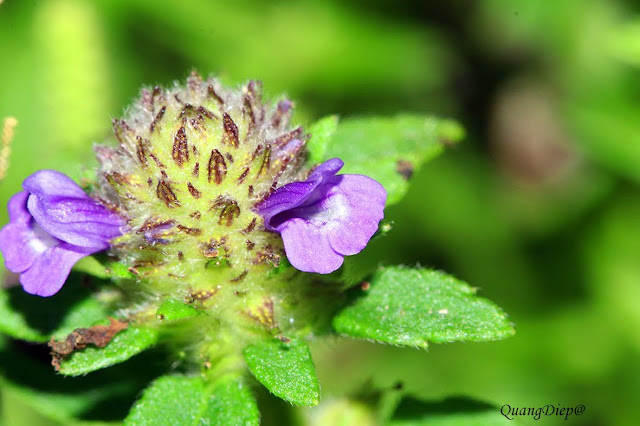
Adenosma indianum
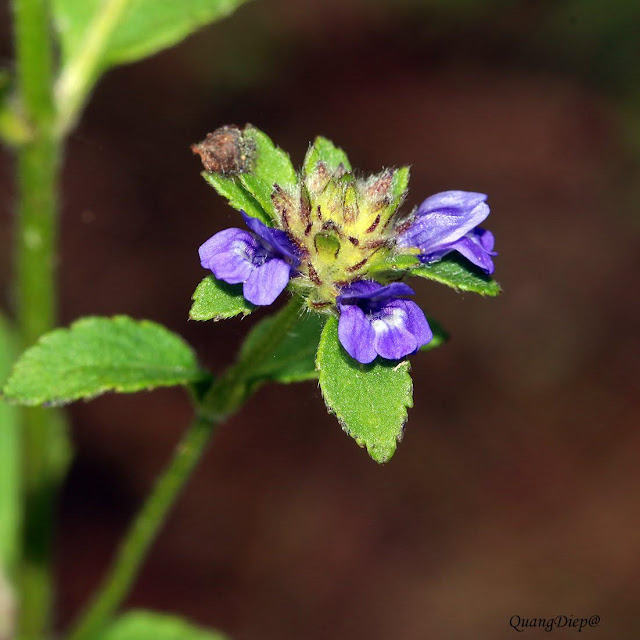
Adenosma indianum
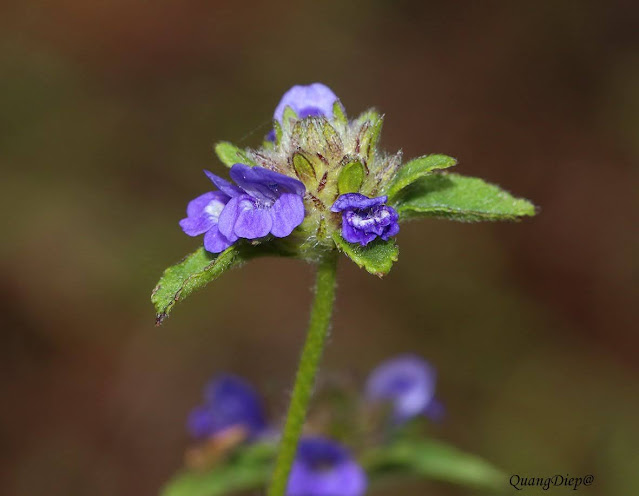
Adenosma indianum
Adenosma indianum (Lour.) Merr.; Photo by Dinh Quang Diep
Botanical name: Adenosma indianum (Lour.) Merr.; Family Scrophulariaceae
Synonyms: Adenosma capitatum (Benth.) Benth. ex Hance; Manulea indiana Lour.; Pterostigma capitatum Benth.; Pterostigma spicatum Benth.; Stoechadomentha capitata Kuntze
Local names: Bồ bồ, Chè đồng, chè nội, chè cát, nhân trần hoa đầu
Description: Annuals, 19-60(-100 or more) cm tall, densely hairy. Stems erect, branched. Petiole 2-6 mm; leaf blade ovate to narrowly elliptic, 1.5-4.5 x 0.5-1.2 cm, densely glandular hairy, abaxially villous along veins and brown when dry, adaxially villous and blackish when dry, margin serrate, apex obtuse. Inflorescences globose to cylindric spicate, 0.7-2 X 0.7-1.1 cm, dense; bracts narrowly ovate, forming an involucre at base of spikes. Flowers sessile. Bracteoles linear, 3-4 mm. Calyx 4-5 mm; lobes narrowly ovate to oblong-lanceolate, 2-3 mm, apex acuminate. Corolla pale purple to dark blue, ca. 6 mm; throat hairy; lower lip lobes equal, suborbicular, ca. 1 X 1-1.2 mm; upper lip retuse to 2-lobed. Anterior anthers with 1 locule fertile; posterior anthers with both locules fertile. Ovary narrowly ovoid. Capsule ovoid, ca. 3 mm, 2-grooved. Seeds yellow. Fl. and fr. Sep-Nov..

Adenosma indianum (Lour.) Merr.
Adenosma indianum (Lour.) Merr.; Family Scrophulariaceae
Distribution:  Commonly found wild in mountainous regions, especially on hillsides and field-edges.
Parts used: The whole plant is collected in summer during its flowering period (Herba Adenosmatis Indiani). It is carefully washed then subjected to thorough air-drying.
Chemical composition:  The plants contain triterpenoid saponins, phenolic acids, coumarins and flavonoids. The volatile oil from the plant consists of L. fenchone 35%, limonene 22.6%, cineol 5.9%, piperitenon oxide and sesquiterpene oxide.
Therapeutic uses:
The whole plant, except the roots, constitutes an antibacterial, cholagogic, diuretic and stomachic remedy. It is useful for the treatment of jaundice in viral hepatitis, oliguria, biliuria, fever, ophthalmalgia, vertigo and dyspepsia in parturients. It is prescribed in a daily dose of 10 to 20g in the form of a decoction, extract or syrup.
Read more

0 Acorus gramineus Soland.; Family Araceae

Local names: Xuong bo, Thach xuong bo, Thuy xuong bo
English name: Dwarf sedge, Japanese rush, Japanese sweet flag, Grass-leaved sweet rush.
Pharmaceutical Name: Rhizome Acori graminei
Description:
Perennial semi-aquatic herb. Rhizome aromatic, creeping and much-branched. Leaves long and amplexicaul, in fascicles; principal nerves parallel. Inflorescence in spike on a compressed scape, surrounded by a long bract; flowers small, bisexual. Berry bright-red when ripe.
Other species, such as Acorus calamus L. and A. gramineus Soland. var. pusillus Engl. are also used medicinally.
Flowering period: March - June.

Acorus gramineus
Acorus gramineus Soland.; Family Araceae 
Part Used & Method for Pharmaceutical Preparations: The rhizomes are dug in early spring and cleaned and dried in the sun. When the fresh rhizome is used for medical purposes, it should be dug in late summer.
Distribution: Grows wild on the banks of mountain streams.
Chemical composition:
The rhizome contains an essential oil consisting of asaron and asaryl aldehyde; and a bitter glucoside, acorin.
Therapeutic uses:
The rhizome possesses pectoral, stomachic and sedative properties. It is utilized in the therapy of diarrhoea, gastralgia, cough, bronchial asthma, neurasthenia, fever, convulsions, rheumatism, osteodynia and arrhythmia.
Indications & Combinations:
1. Unconsciousness due to blockage of the pericardium by turbid phlegm or accumulation of dampness and heat. Grass-leaved sweetflag (Thach xuong bo) is used with fresh Bamboo juice (Truc nhu) and Curcuma root (Uat kim) in the formula Xuong bo Uat kim Thang.
2. Dampness blocking the middle jiao (spleen and stomach) manifested as stifling sensation, distension and pain in the chest and abdominal region. Grass-leaved sweetflag (Thach xuong bo) is used with Tangerine peel (Tran bi) and Magnolia bark (Hau Phac).
3. Damp-heat blocking the middle jiao manifested as dysentery and vomiting after meals. Grass-leaved sweetflag (Thach xuong bo) is used with Coptis root (Hoang lien).
4. Insomnia, forgetfulness, tinnitus and deafness. Grass-leaved sweetflag (Thach xuong bo) is used with Polygala root (Vien chi) and Poria (Phuc linh) in the formula Anshen Dingzhi Wan.
Dosage: The daily dose is 3 to 8g in the form of a decoction, powder and pills, for a period of 1 to 2 months. External application is effective for dermatosis and haemorrhoids. It is also used as an insecticide for killing lice, bugs and fleas (double dosage for the fresh herb).
Read more

1 Aconitum fortunei Hemsl.; Ranunculaceae-Therapeutic uses

Botanical Name: Aconitum fortunei Hemsl.
Local names: Ô đầu, củ ấu tàu
Description:
Perennial herbaceous plant, 0.6-1 m. high. Roots paired, tuberous, conical with mother-tuber and daughter-tuber. Stem erect, cylindrical, glabrous. Leaves of two kinds: the lower cordate, crenated; the upper 3- palmatipartite, sharply denticulate. Inflorescence in terminal raceme; flowers blue. Follicles: 5, sessile, oblong, divergent. Seeds winged.

Aconitum fortunei Hemsl.;Family Ranunculaceae
Flowering period: October - November.
Distribution: Grows wild in the high mountains.
Parts used: The tuberous roots are collected in autumn before the plant flowers, and sun-dried.
Chemical composition: The tuberous roots contain the alkaloid aconitine.
Therapeutic uses:
The tuberous roots are used in treating rheumatism, paresis, arthralgia, luxation, sprains and contusions. Their tincture is used as liniment. It must not be taken by mouth, because of its high toxicity.
Indications & Combinations:
1. Collapsing of yang syndrome manifested as cold extremities, spontaneous cold sweating and fading pulse. Prepared aconite root (Phu tu) is used with Dried ginger (Can Khuong) and Licorice root (Cam thao) in the formula Sini Tang.
2. Collapsing of yang qi syndrome manifested as profuse sweating, shortness of breath and asthma. Prepared aconite root (Phu tu) is used with Ginseng (Sinh khuong) in the formula Sinh Phu thang.
3. Deficiency of kidney yang and declined kidney fire manifested as chills, cold limbs, soreness and weakness of lumbar region, impotence and frequent urination. Prepared aconite root (Phu tu) is used with Cinnamon bark (Que nhuc), Dogwood fruit (Shanzhuyu) and Prepared rehmannia root (Sinh dia).
4. Weakness of spleen yang manifested as cold in the epigastric and abdominal regions and diarrhea. Prepared aconite root (Phu tu) is used with Ginseng (Sinh khuong), White atractylodes (Bach truat) and Dried ginger (Can khuong) in the formula Phu tu ly trung thang.
5. Heart yang deficiency manifested as palpitations, shortness of breath and stifling sensation and pain in the chest. Prepared aconite root (Phu tu) is used with Ginseng (Sinh khuong) and Cinnamon twigs (Que chi).
6. Deficient yang in the spleen and kidneys manifested as dysuria and general edema.Prepared aconite root (Phu tu) is used with White atractylodes (Bach truat) and Poria (Phuc linh).
7. Weakness of defensive yang manifested as spontaneous sweating. Prepared aconite root (Phu tu) is used with Astragalus root (Hoang ky) and Cinnamon twigs (Que chi).
8. Invasion by wind and cold in a person with deficient yang. Prepared aconite root (Fuzi) is used with Ephedra (Ma hoang) and Asarum herb (Te tab) in the formula Ma hoang Phu tu Te tan Thang.
9. Cold-damp obstruction syndrome manifested as general joint pain and chills.Prepared aconite root (Phu tu) is used with Cinnamon twigs (Que chi) and White atractylodes (Bach truat).
Dosage: 3-15 g, decocted in water for an oral dose; 1–2 g, if used in powder.
Cautions & Contraindications:
1. Due to toxicity, Radix Aconiti must be decocted in water 30–60 minutes before the other herbs.
2. It is contraindicated for use during pregnancy.
3. It is incompatible with Rhizoma Pinelliae (Ban ha), Fructus Trichosanthis (Qua lau), Bulbus Fritillariae Cirrhosae (Xuyen Boi Mau), and Rhizoma Bletillae Striatae (Bach cap).
Read more

0 Achyranthes bidentata Blume; Amaranthaceae

Botanical Name: Achyranthes bidentata Blume; Amaranthaceae
Local names: Nguu tat
Description:
Perennial herbaceous plant, 60-80 cm. high. Tuberous roots long, cylindrical. Stems angular, swollen at the nodes. Leaves opposite, elliptic to linear-lanceolate, short-petioled, with margins undulate. Inflorescence in terminal spike; flowers greenish-white, numerous, deflected against the rachis. Utricle oblong-cylindrical, one-seeded.

Achyranthes bidentata Blume; Amaranthaceae
Achyranthes bidentata Blume; Amaranthaceae

Flowering period: May - July.
Distribution: An introduced species, it is cultivated in the plains.
Parts used:
The tuberous roots, collected in winter and spring, are exposed to the sun until half-dried, then wrapped up for 7 days until the skin is seamed with wrinkles. They are subjected to sulfur fumigation and further drying. The drug is normally used unprocessed but sometimes before being used it is soaked in alcohol and torrefied until it becomes yellow.
Chemical composition:
Bidentatoside,. Bidentatoside II, and chikusetsusaponin V methyl ester. n-butyl-beta-D-fructopyranoside, oleanoic acid, 3-O-[beta-D-glucopyranosyl], oleanoic acid 28-O-beta-D-glucopyranoside, allantoin, 20-hydroxy ecdysone, glutamic acid, 3-O-[beta-D-glucopyranosyl], oleanoic acid 28-O-beta-D-glucopyranosyl ester. Achyranthesterone A (2beta, 3beta, 14alpha, 20S, 21, 22R, 25-heptahydroxycholest-7-en-6-one, a phytosterone), 26-pentahydroxy-cholestan-7,12-dien-6-one Researchers from Nanjing University isolated five oleanolic acid glycosides and they all inhibited the formation of  osteoclast-like multinucleated cells.
Therapeutic uses:
The roots possess anti-inflammatory, hypocholesterolaemic, hypotensive and uterotonic properties. The drug is indicated for rheumatism, lumbago, dysmenorrhoea, hypertension, hypercholesterolaemia, atherosclerosis, dysuria, haematuria, contusions, congestion and sore throat. It is also used as an oxytocic in dystocia, placenta retention and post-partum haematometra.

Indications & Combinations:
1. Blood stagnation manifested as amenorrhea, dysmenorrhea, irregular menstruation and pains due to external injuries. Cyathula root (Niuxi) is used with Peach seed (Taoren), Safflower (Honghua), Chinese angelica root (Danggui) and Corydalis tuber (Yanhusuo).
2. Deficiency of the liver and kidneys manifested as soreness and weakness in the lumbar region and legs. Cyathula root (Niuxi) is used with Mulberry mistletoe (Sangjisheng), Eucommia bark (Duzhong) and Cibot rhizome (Gouji).
3. Extravasation of blood by heat manifested as vomiting with blood and epistaxis.Cyathula root (Niuxi) is used with Small thistle (Xiaoji), Biota tops (Cebaiye) and Imperata rhizome (Baimaogen).
4. Deficient yin with hyperactive yang leading to internal liver wind going upward manifested as headache, dizziness and vertigo. Cyathula root (Niuxi) is used with Red ochre (Daizheshi), Oyster shell (Muli) and Dragon's bone (Longgu) in the formula Zhengan Xifeng Tang.
5. Deficient yin and excessive fire manifested as ulceration of the mouth and gum swelling. Cyathula root (Niuxi) is used with Fresh rehmannia root (Shengdihuang) and Anemarrhena rhizome (Zhimu).
6. Urinary tract disorders manifested as painful urination, hematuria and dysuria.Cyathula root (Niuxi) is used with Ricepaper pith (Tongcao), Talc (Huashi) and Pink (Qumai) in the formula Niuxi Tang.
Dosage: It is prescribed in a dose of 6 to 12g per day in the form of a decoction.
Cautions & Contraindications: This herb is contraindicated during pregnancy, or with profuse menstrual flow.
Read more

0 Achyranthes aspera L.; Amaranthaceae-Therapeutic uses

Local names: Co xuoc, Nguu tat nam, Tho nguu tat
English name: Prickly chaff-flower.
Description:
Herbaceous plant about 1m. high. Stems erect, pubescent, swollen at the nodes. Leaves opposite, short-petioled, margins undulate. Flowers numerous, stiffly deflected against the pubescent rachis in elongate terminal spike, 20-30 cm. long. Utricle oblong-cylindrical, enclosed in the hardened perianth, brown. Seeds oblong-ovoid.

Achyranthes aspera L.; Amaranthaceae

Flowering period: July - December.
Distribution: Grows wild along roadsides.
Parts used: The whole, plant, especially the roots. Collected throughout the year, they are carefully washed and sun-dried or heat-dried.
Chemical composition:
Leaves, stems and roots contain alkaloids, sterol and saponins. Root contains ecdysone, ecdysterone (polypodine A) and insect moulting hormones. Seeds contain saponin A&B. Fruit contains two oleanolic acid based saponins. The plant also contains an alkaloid achyranthine (=betaine), amino acids, arginine, histidine, lysine, cystine, threonine, methionine, lucine, isolucine, phenylalanine, tryptophan and carbohydrate, valine, α-rhamnopyranosyl, ß-D glucopyranosyl, ß-D galactopyranosyl, galactose, xylose, rhamnose and glucose, large amount of potash, hormones, ecdysterone and inokosterone. (Asolkar et al., 1992; Rastogi & Mehrotra, 1993; Ghani, 2003; Qureshi and Bhatti 2006).
Therapeutic uses:
The whole plant and especially the roots, characterized by their anti-inflammatory and uterine stimulant activity, are prescribed in the therapy of rheumatism, contusions, lumbago, osteodynia, dysuria, post-partum haematometra and dysmenorrhoea. The daily dose is 8 to 16g in the form of a decoction. The drug is used on its own or in combination with some other plants.
epharmacognosy.com
Read more

0 Acanthopanax trifoliatus (L.) Merr.; (Family Araliaceae)-Therapeutic uses

Botanical name: Acanthopanax trifoliatus (L.) Merr.; (Family Araliaceae)
Local names: Ngu gia bi huong
Description:
Rigid shrub, diffuse. Stems ascending, spiny. Leaves alternate, 3-5 - palmifoliate; leaflets with margins toothed and spines on the nerves. Inflorescence in terminal panicle of some umbels; flowers small, greenish-white. Fruit globose, black when ripe. All parts of the plant are particularly fragrant.

Acanthopanax trifoliatus (L.) Merr.; (Family Araliaceae)
Acanthopanax trifoliatus (L.) Merr.; (Family Araliaceae)

Flowering period: September - November.
Distribution: Grows wild in mountainous regions, occasionally found on the forest-edge.
Parts used: The root bark and stem bark are collected in summer and autumn. The bark is wrapped to bring out the aroma then subjected to thorough air-drying.
Chemical composition: The root bark and stem bark contain triterpenoid saponins and oleanolic acid
Properties: Bitter and astringent tasting; cool.
Functions: Antipyretic, anti-inflammatory, antirheumatic stagnant blood dispelling, analgesic.
Therapeutic uses:
The root bark and stem bark are prescribed in the treatment of rheumatism, lumbago, ostealgia and impotence. The drug is also considered as a central nervous system stimulant and tonic. It improves the memory. The usual dose is 6 to 12g per day in the form of a decoction or tincture.
Read more

0 Abutilon indicum (L.) Sweet; (Family Malvaceae)-Therapeutic uses

Botanical name: Abutilon indicum (L.) Sweet; (Family Malvaceae).
Local names: Coi xay, giang xay, quynh ma.
English names: Country mallow, Indian mallow, Indian abutilon.
Description:
Abutilon indicum (L.) Sweet is an erect woody undershrub. Leaves ovate, cordate irregularly toothed, covered on both surfaces with white down. Flowers solitary, axillary; calyx 5-lobed, tubular below, lobes ovate-acute; corolla yellow, petals 5, connate below and adnate to the tube of the stamens. Ripe carpels 15-20, longer than the calyx, truncate or shortly awned.

Abutilon indicum (L.) Sweet; (Family Malvaceae)
Abutilon indicum (L.) Sweet; (Family Malvaceae)

Flowering period: February - April.
Distribution: Wild and cultivated species.
Parts used:
The whole plant is collected in summer and autumn and used fresh or dried.
Chemical composition:
Leaves and other aerial parts contain mucilage, tannin, alkanol, flavonoids, saponins, cyanidin-3-rutinoside, asparagin, ß-amyrin, ß- sitosterol, eudesmol, geraniol, caryophylline, sesquiterpene lactones, tocopherol oil (0.3%), essential oil and eugenol. Seeds yield raffinose and a semi-drying oil consisting of linoleic, oleic, palmitic and stearic acids (Ghani, 2003). Plant also contains gossypetin -8 & 7-glucosides, cyaniding-3-rutnoside (Asolkar et al., 1992).
Therapeutic uses:
The roots and leaves are employed in the treatment of coryza, hyperthermia, headache, dysuria and metrorrhoea, in a daily dose of 4 to 8g of dried plant material in the form of a decoction. The juice of pounded fresh leaves and seeds internally applied is active on furunculosis, dysentery and snake-bite; the residue is used for poultices. The dose of seeds is 8 to 12g per day. A combination with some other plants is prescribed for jaundice and certain post-partum diseases.
Read more

0 Abrus precatorius L. (Family Fabaceae)-Therapeutic uses


Botanical name: Abrus precatorius L. (Family Fabaceae)
Local names: Cam thao day, day chi chi, cuom thao, tuong tu dang.
English names: Jequirity, Indian liquorice, wild liquorice, crab-eye vine, coral pea, prayer beads, rosary pea.
Description:
Abrus precatorius L. is a deciduous dextrose climber with slender flexible branches. Leaves peripinnate, 5-10 cm long; leaflets 20-40, ligulate-oblong 1-1.6 cm long. Racemes many-flowered, crowded, usually shorter than the leaves. Corolla white, 3-4 times the calyx c. 2 mm. Pods oblong, turgid, 2.5-3.7 cm long. Seeds small, ovoid, bright scarlet with a black spot at the hilum.
Abrus precatorius
Abrus precatorius L. (Family Fabaceae)

Flowering period: June - August.
Distribution: Grows wild in mountainous regions; also cultivated.
Parts used:
The roots, leaves and stem are collected in autumn during the flowering period. They are used fresh or dried. The seeds are toxic and only used externally.
Chemical composition:
Seeds contain two lectins, abrin-a and abrin-b, indole alkaloids and anthocyanins. Three toxins, abrin I, II, and III, and agglutinins have been isolated from seeds. Seeds also contain the alkaloids abrine, hypaphorine, trigonelline and choline; flavons, abrectorin and aknone; gallic acid, keto steroid P-sterone, other steroids, abricin, abridin and cholesterol, stigmasterol, β-sitosterol, terpenoids, squalene and urease enzyme.
It also contains amino acids - alanine, serine & valine. Leaves contain glycyrrhizin and abrins. Roots also contain glycyrrhizin, an acid resin, precol, abrol; alkaloids, abrasine and precasine, and isoflavaquinones, abrusquinone A, B and C and also polysaccharides. A saturated alcohol and pinitol have been isolated from waxy material of leaves (Ghani, 2003; Rastogi & Mehrotra, 1990 & 93).
Therapeutic uses:
The roots, the stem and the leaves are effective in the treatment of coryza, cough, fever, jaundice resulting from viral hepatitis, and intoxications. They are used as an edulcorating agent in composite recipes. The daily dose is 8 to 16g in the form of a decoction. The seeds, very toxic, are applied externally in an antiseptic and anti-inflammatory poultice to accelerate the bursting of boils and to cure mastitis and galactophoritis.
Read more
 
© Pharmacognosy | Plants | herbal | herb | traditional medicine | alternative | Botany | © Copyright 2012 ; Email: epharmacognosy@gmail.com